Banksy’s Hornsey Road Tree Mural: Climate Change, Greenwashing and the Illusion of Environmental Repair
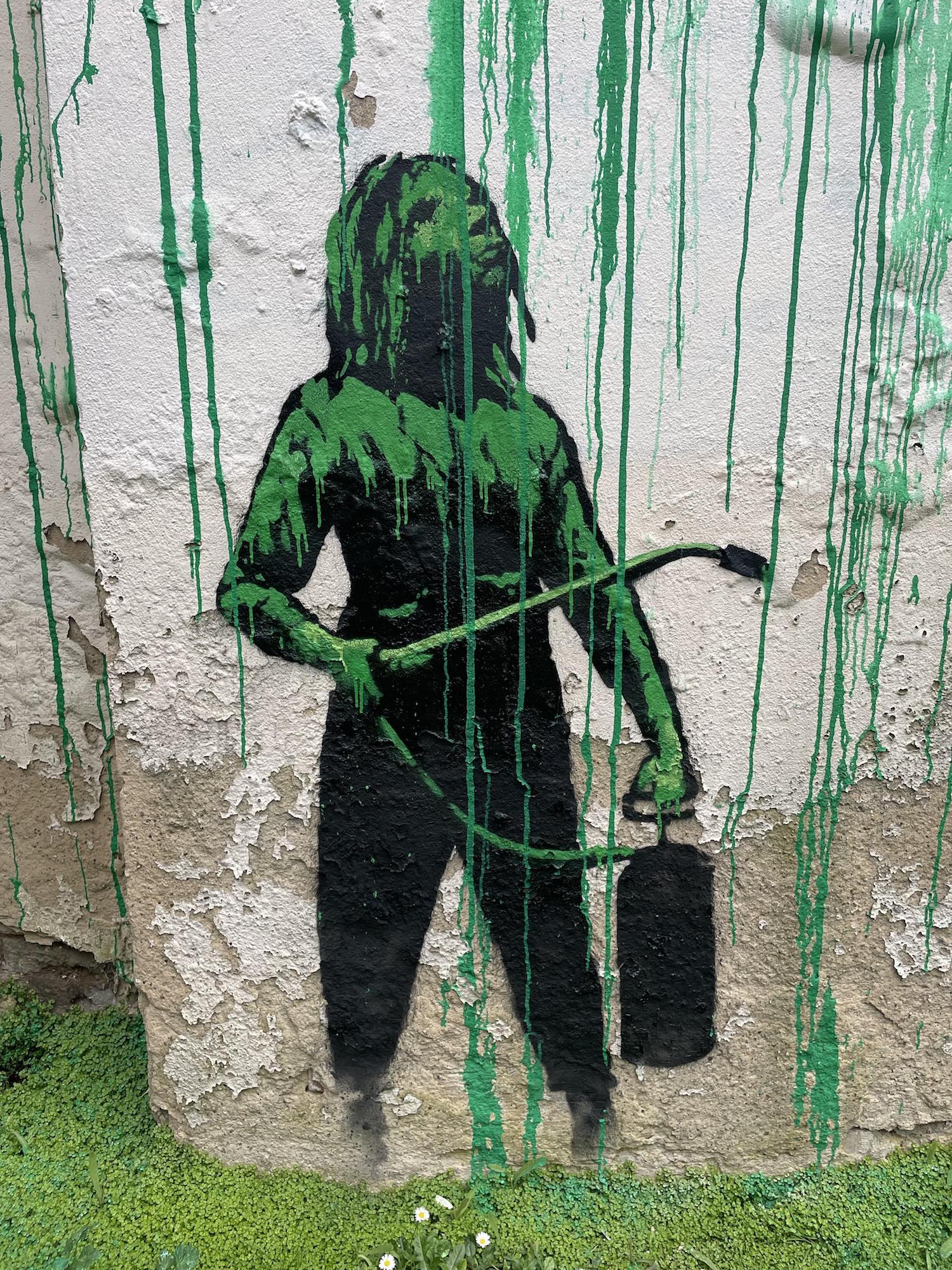
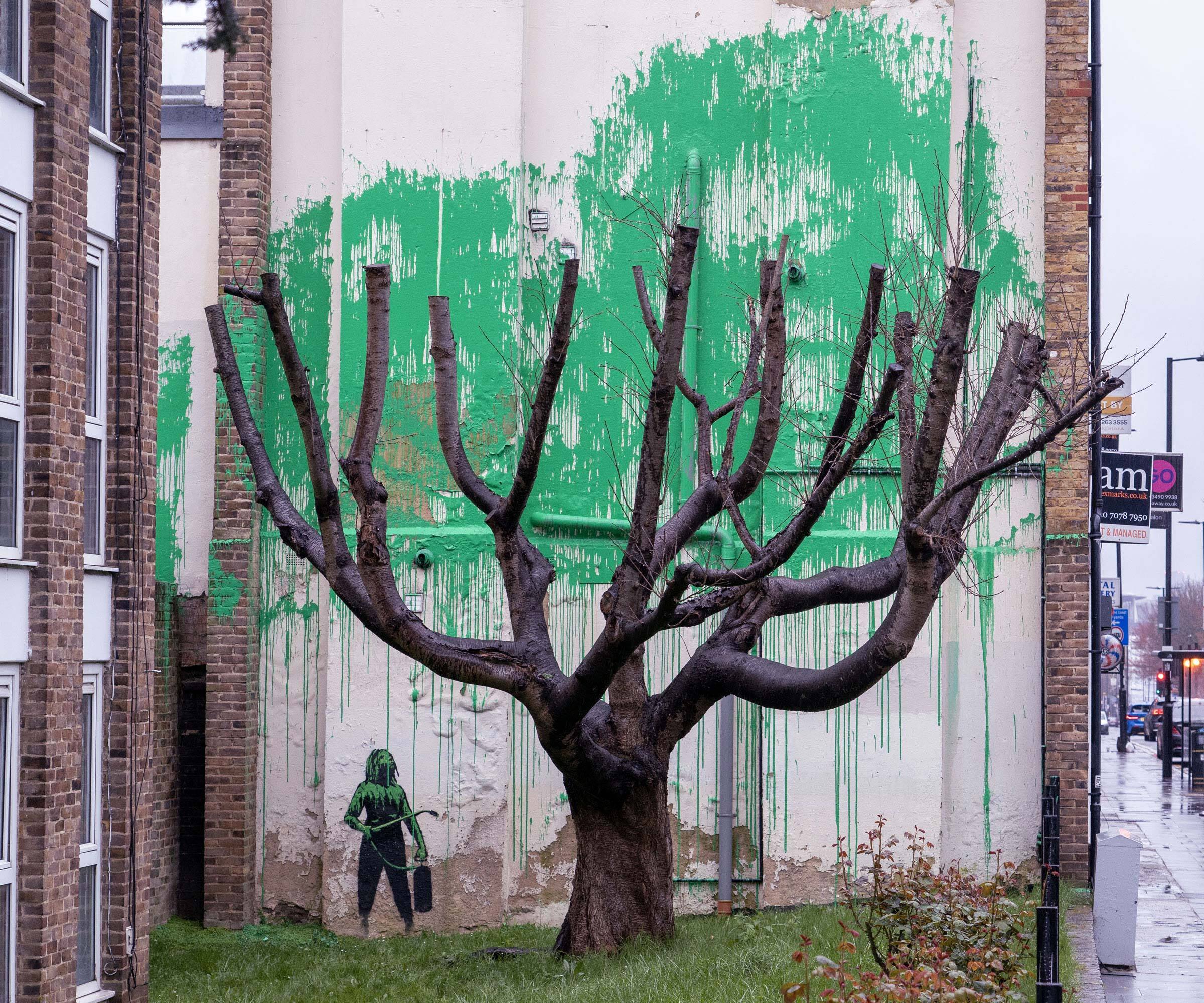
Banksy’s Hornsey Road tree mural, which appeared in Finsbury Park, north London, in March 2024, is widely interpreted as a commentary on climate change, urban nature and greenwashing. The artwork combines a heavily pruned cherry tree with a painted green canopy and a stencilled figure holding a pressure hose, creating the illusion that the tree’s missing foliage has been restored.
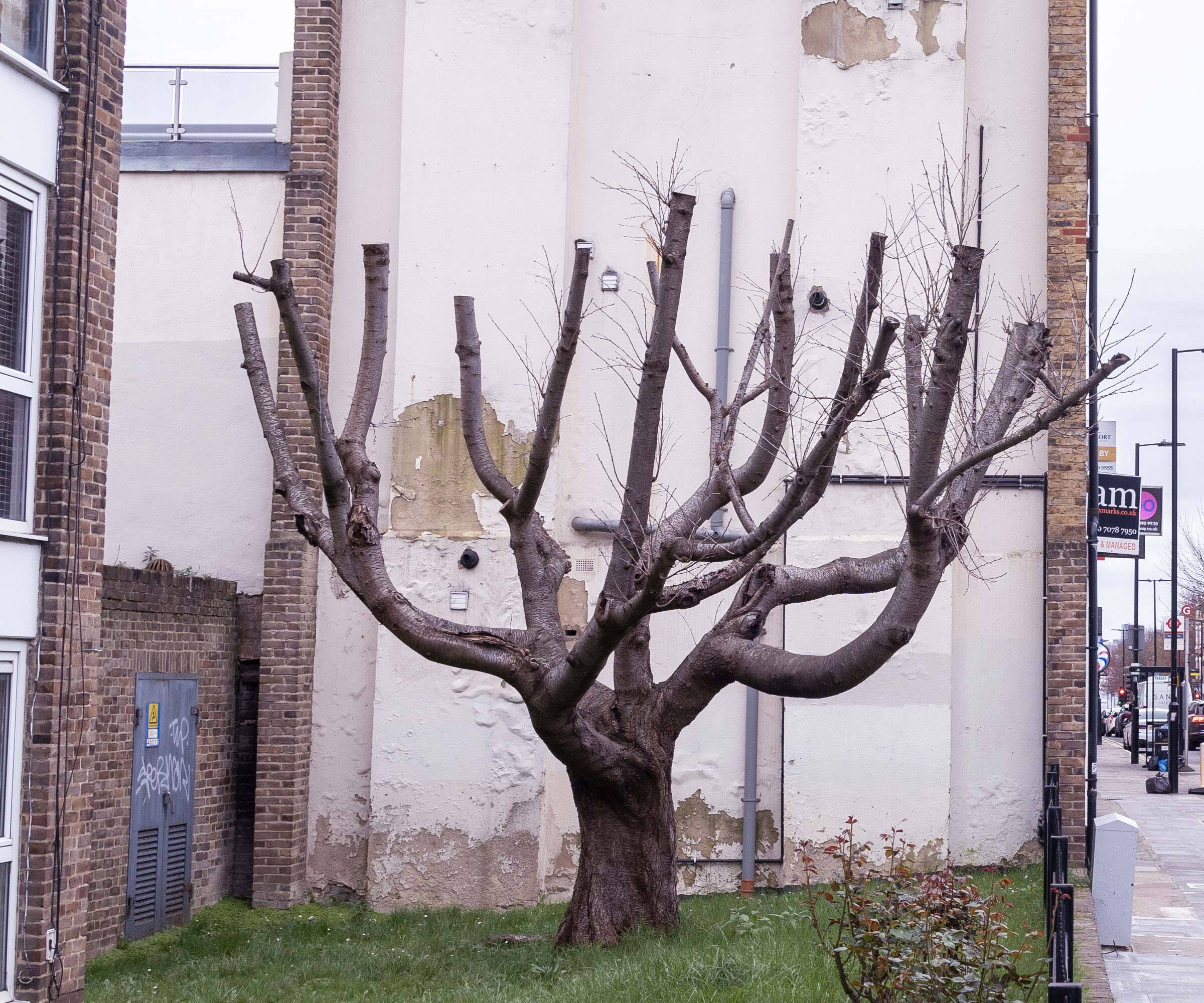
Yet the restoration is only visual. The living tree remains bare while the wall behind it performs the appearance of environmental recovery, turning the mural into a compelling critique of greenwashing and the ease with which ecological damage can be concealed beneath reassuring images of sustainability.
Banksy’s Hornsey Road tree mural, Finsbury Park, London. Image copyright GraffitiStreet.
- What Does Banksy’s Hornsey Road Tree Mural Show?
- Is Banksy’s Tree Mural About Climate Change?
- Is the Hornsey Road Mural a Comment on Greenwashing?
- The Influence of Environmental Protest
- The Living Tree Is the Artwork’s Most Important Element
- Protection, Damage and the Contradictions of Value
- What Is the Meaning of Banksy’s Hornsey Road Tree Mural?
- Banksy Turns Greenwashing into a Physical Image
- Frequently Asked Questions
- Explore Banksy with GraffitiStreet
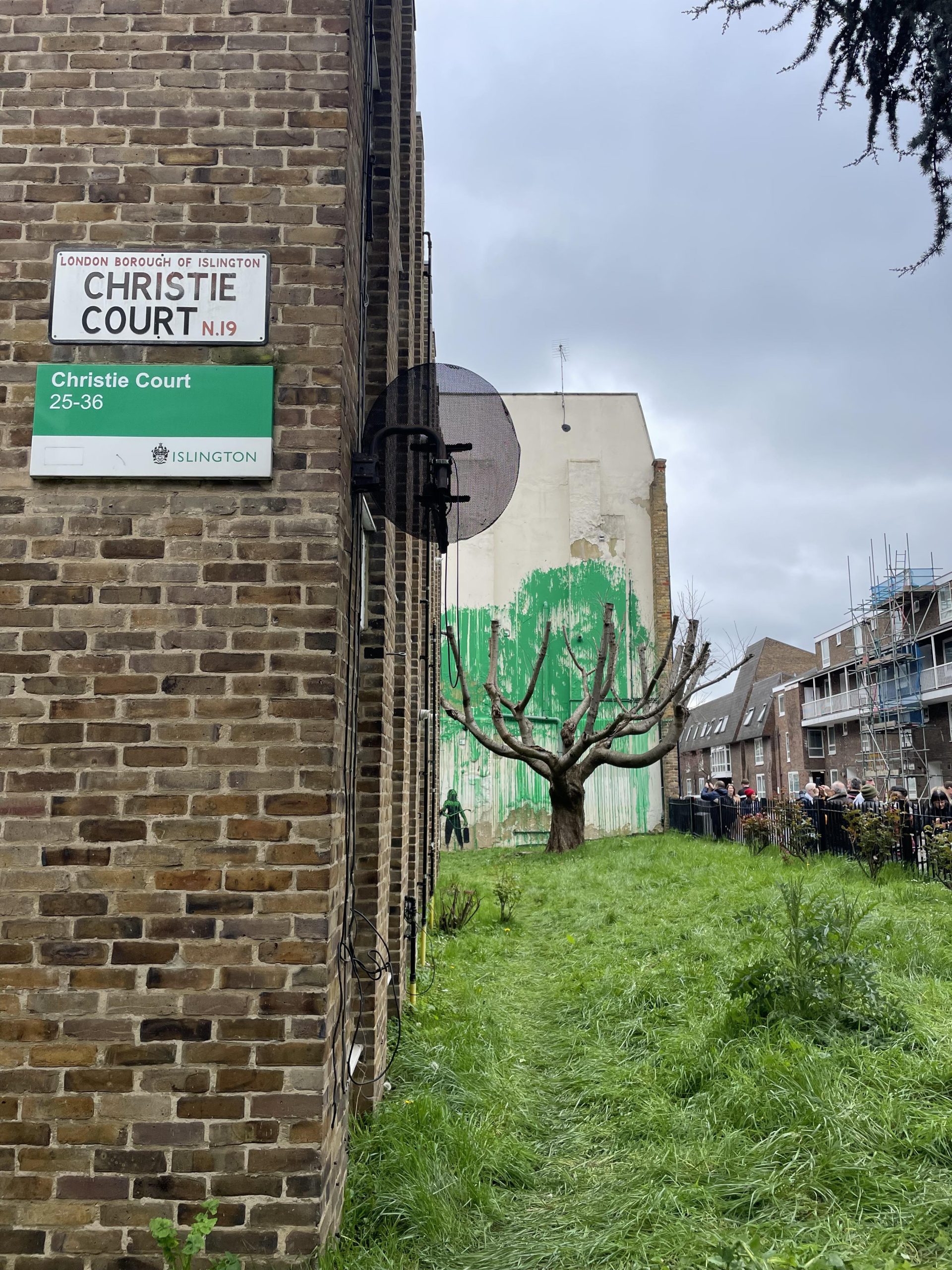
Banksy confirmed the artwork through his official Instagram account on Monday 18 March 2024, after residents and visitors had already begun gathering at the site. The artist’s photographs showed the wall before and after the intervention, establishing the living tree as an essential part of the composition rather than incidental street furniture.
The mural was widely interpreted as a commentary on climate change, urban nature and the environmental pressures placed upon mature trees. However, its meaning becomes more complicated when the painted canopy is considered for what it actually is: an image of natural abundance placed behind a tree that remains bare. Banksy does not restore nature to Hornsey Road. He replaces its visible absence with green paint.
That distinction opens the work to a more pointed reading about greenwashing, the practice of presenting an environmentally responsible image without making changes substantial enough to address the damage beneath it.
What Does Banksy’s Hornsey Road Tree Mural Show?
The mural is formed from three elements: the existing cherry tree, a large field of green paint across the residential wall behind it, and a stencilled figure holding what appears to be a pressure hose or spraying device.
From the intended viewpoint, the green marks align with the tree’s branches and create the impression of an abundant canopy. The effect depends on the physical relationship between artwork, architecture and nature. Without the tree, the painted area would appear largely abstract; without the green wall, the severity of the tree’s pruning would remain exposed.
Banksy has not simply painted an image of a tree. He has used a real tree as the central subject and material of the artwork, allowing the wall behind it to perform the role of its missing foliage.
The green paint has been applied loosely, with drips running down the building rather than carefully rendered leaves or branches. Its roughness gives the intervention the immediacy of an urgent public action, but it also prevents the canopy from becoming entirely convincing. The illusion works from a distance, while its artificiality remains unmistakable at close range.
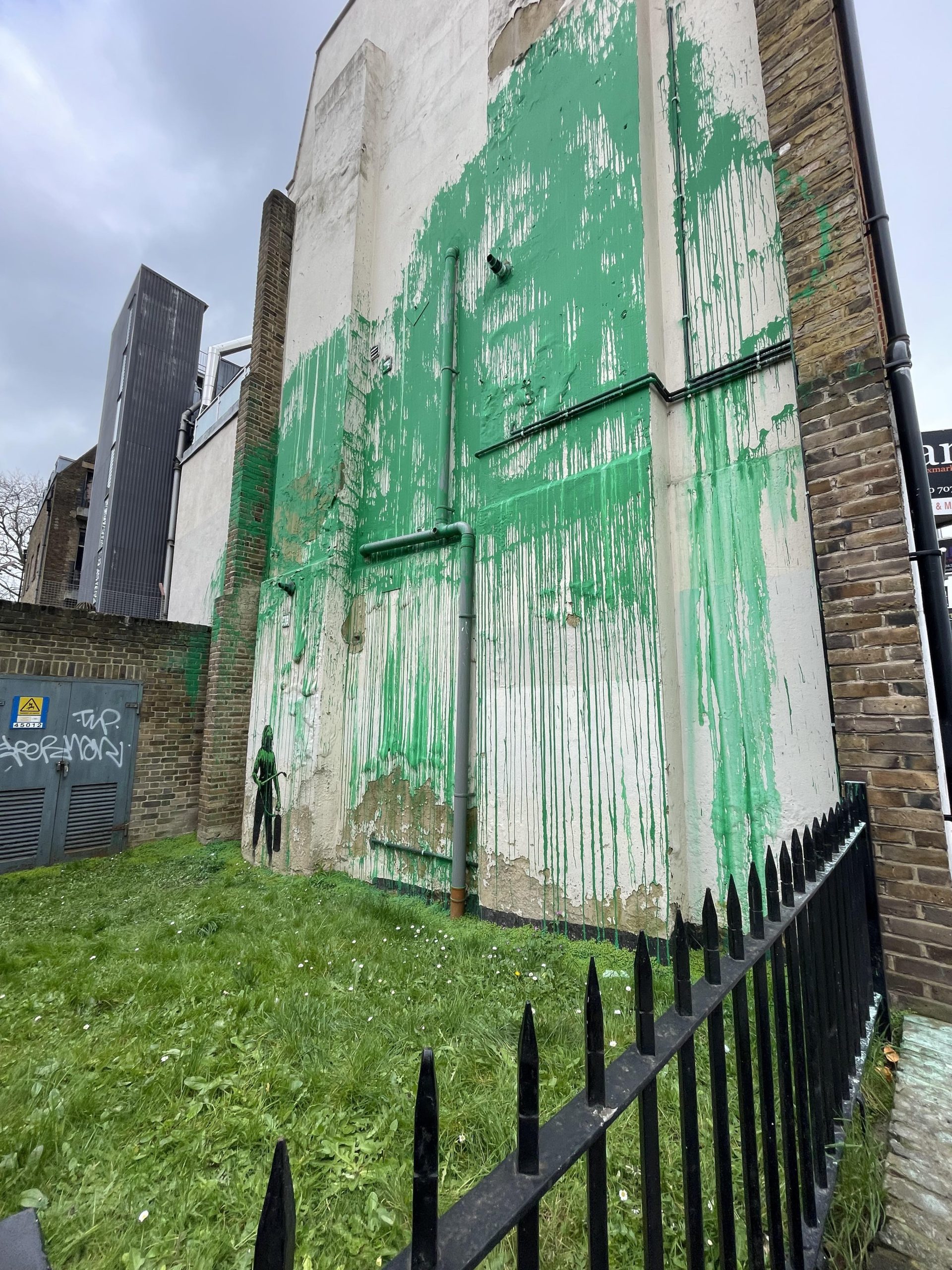
Banksy “Tree” Mural, Hornsey Road. Image Copyright GraffitiStreet
Is Banksy’s Tree Mural About Climate Change?
The most immediate interpretation of Banksy’s Hornsey Road tree mural is environmental. A living tree appears depleted, while the painted surface behind it attempts to return the greenery that has been removed.
The work can be understood within the broader realities of climate change, habitat loss and the reduction of natural space within densely developed cities. Mature urban trees provide shade, help moderate temperatures, capture carbon, absorb rainfall, filter pollutants and support birds and insects. Their value cannot be replicated simply by adding the colour green to the built environment.
The cherry tree used by Banksy was reported to be approximately 40 to 50 years old and in declining health, with decay and fungal damage. Islington Council stated that it had been managing the tree in an effort to prolong its life, while tree campaigners questioned whether the severity of the pruning reflected a wider failure to treat mature urban trees with sufficient care.
Pollarding and substantial pruning can be legitimate forms of tree management, particularly where older trees occupy constrained urban environments. Trees for Cities noted that such work is commonly carried out while a tree is dormant and may be used to manage growth around buildings and infrastructure.
Banksy’s mural does not resolve that technical debate. Instead, it transforms the visible result into a public image, placing the contrast between the tree’s living condition and its painted substitute directly before the viewer.

Banksy “Tree” Mural, Hornsey Road. Image Copyright GraffitiStreet
Is the Hornsey Road Mural a Comment on Greenwashing?
The use of green paint makes greenwashing one of the mural’s most compelling interpretations.
Greenwashing describes the use of environmental branding, imagery or language to create the impression of ecological responsibility while avoiding the structural changes required to deliver it. Banksy’s mural translates that idea into an unusually direct visual form: the tree remains diminished, but its appearance has been improved by covering the wall behind it in green. From the correct position, the landscape looks repaired. Materially, almost nothing has changed.
The painted canopy cannot cool the street, shelter wildlife, absorb carbon or produce blossom. It supplies the visual language of environmental recovery without any of its ecological functions. Banksy’s intervention therefore resembles the way institutions, corporations and governments may use sustainability claims to soften the appearance of environmental harm without addressing its underlying causes.
The particular shade of green also attracted attention because of its similarity to the green used on Islington Council signage. Commentators suggested that this may have been a deliberate decision, although Banksy offered no written explanation confirming that interpretation.
Banksy’s mural asks how readily environmental concern can become a matter of presentation, with the reassuring appearance of green used to conceal more difficult realities about development, pollution, public space and ecological decline.
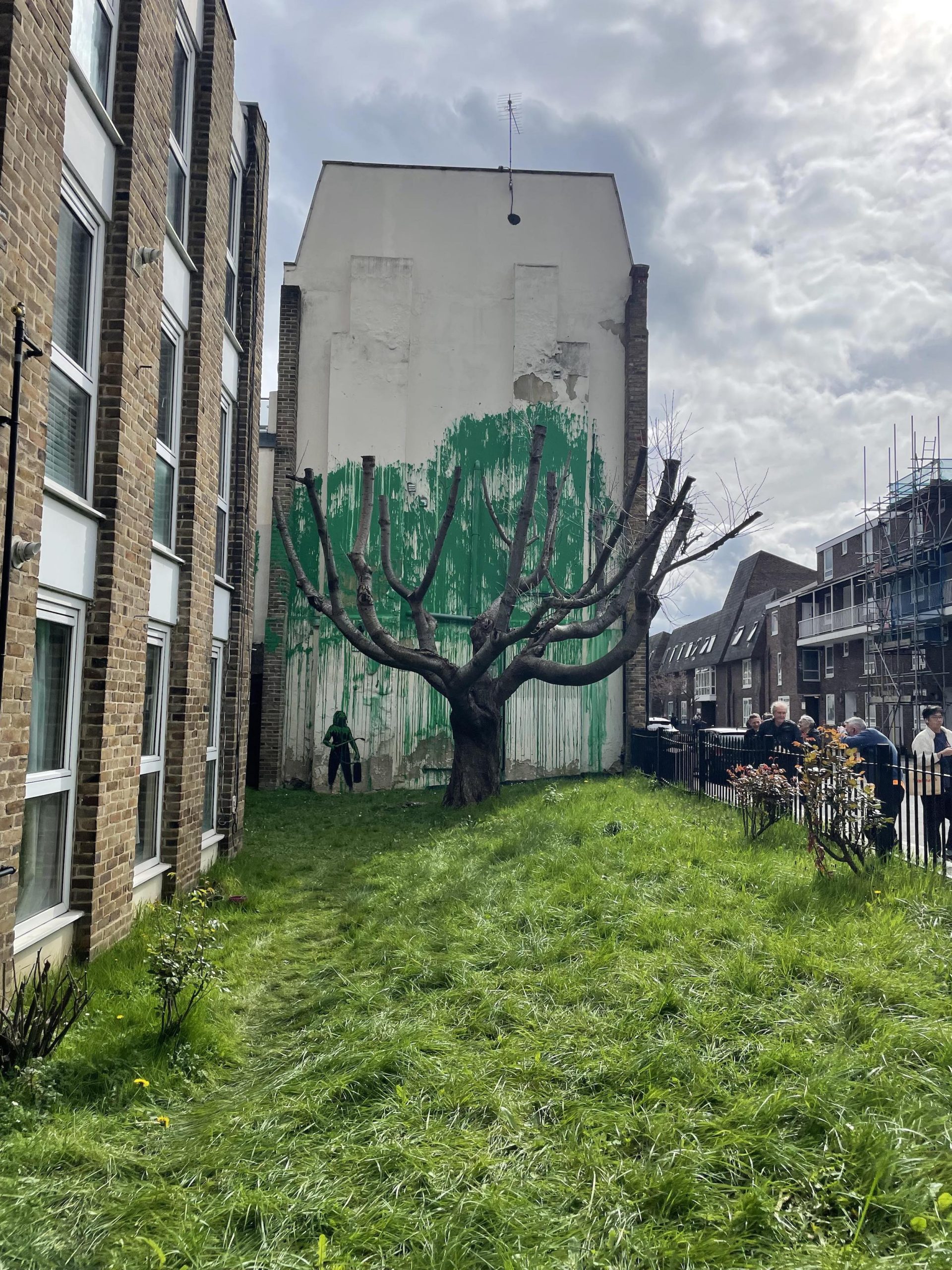
The painted canopy restores the appearance of nature while leaving the condition of the living tree unchanged. Image copyright GraffitiStreet.
The Influence of Environmental Protest
The stencilled figure and spraying equipment recall the methods associated with contemporary environmental protest, particularly actions in which paint is projected across buildings, artworks or public institutions.
Groups including Just Stop Oil have used fire extinguishers and pressurised devices to spray orange paint during demonstrations calling for an end to new oil and gas licensing. Banksy appears to borrow the visual language of those actions while reversing their familiar colour. Instead of coating a public surface in warning orange, the figure covers environmental absence in green.
The connection should be understood as an echo rather than a confirmed reference, since Banksy did not provide an accompanying statement. Nevertheless, it adds another layer of ambiguity to the work.
The figure could be interpreted as an activist attempting to return life to a damaged landscape. Equally, the figure may represent the authority responsible for disguising that damage with a more acceptable image.
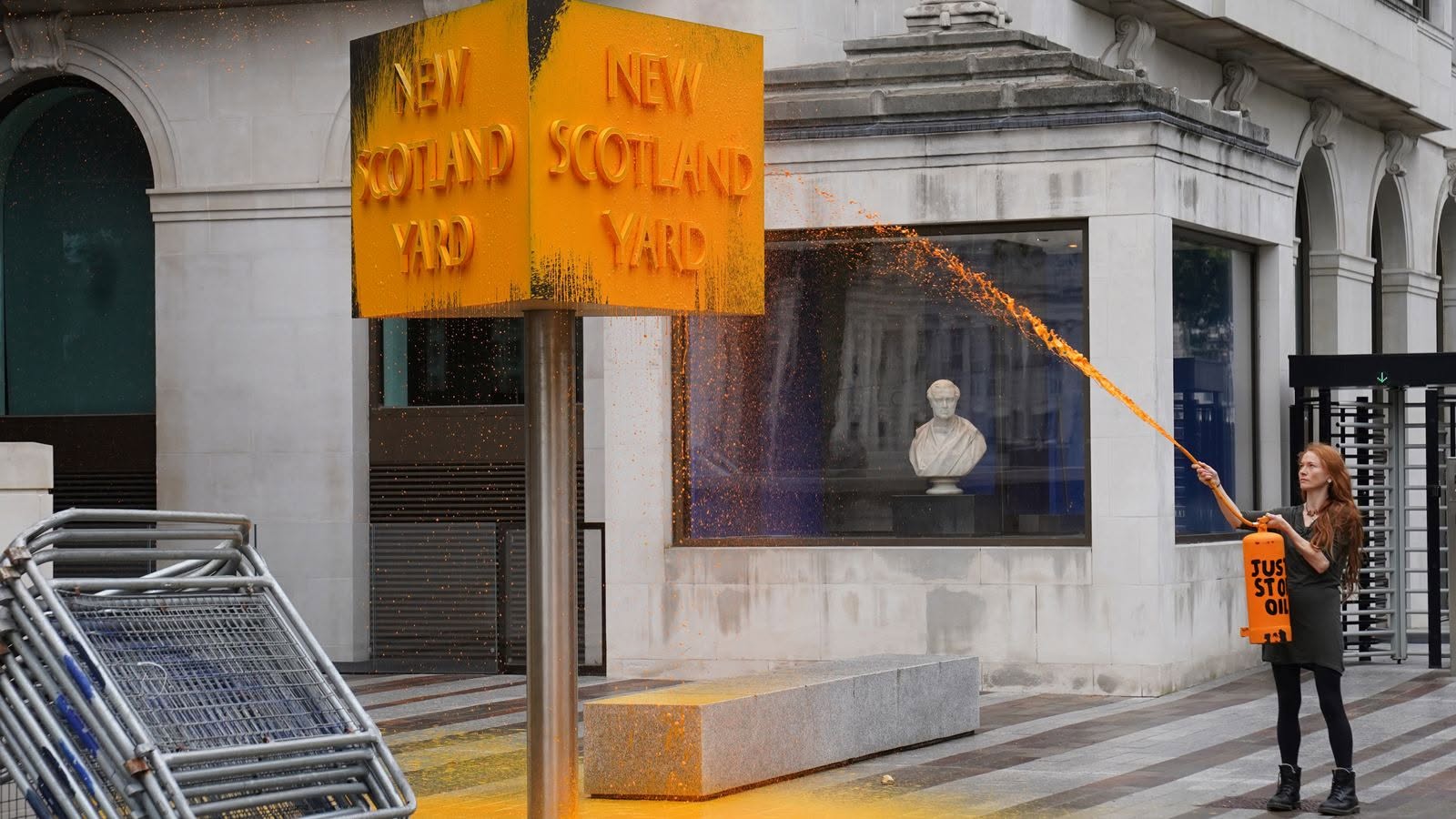
Lora Johnson Painting New Scotland Yard, October 2022. Image copyright Just Stop Oil
The Living Tree Is the Artwork’s Most Important Element
Much of the attention surrounding the mural initially focused on Banksy’s identity, the value of the building and whether the artwork could be removed or sold. Yet the composition resists easy separation from its location because the tree is not simply positioned in front of the mural; it completes it.
This site-specific relationship makes the Hornsey Road work materially different from a stencil that can be cut from a wall and transferred into an auction room. Removing the painted section would preserve only part of the image, while separating it from the cherry tree would weaken the environmental argument on which the work depends.
Banksy Hornsey Road tree mural in Finsbury Park, London. Image copyright Banksy
Protection, Damage and the Contradictions of Value
Within days of its appearance, Banksy’s Hornsey Road tree mural was defaced with white paint. Fencing was introduced around the site, and further protective measures were subsequently installed as the building owner, council and residents attempted to manage the crowds and preserve the work.
The speed with which the mural became a protected cultural asset also revealed how society assigns value. Once Banksy’s authorship had been confirmed, the painted representation of foliage acquired cultural, financial and touristic importance. The mature cherry tree had occupied the same location for decades, yet it was the arrival of the artificial canopy that drew international attention.
Banksy “Tree” Mural, Hornsey Road. Image Copyright GraffitiStreet
What Is the Meaning of Banksy’s Hornsey Road Tree Mural?
Banksy’s Hornsey Road tree mural is best understood not as a single statement about climate change, but as an artwork built upon the tension between environmental reality and environmental appearance.
Its first message is accessible and immediate: cities need trees, and the loss of mature greenery leaves an absence that cannot be ignored. Yet the intervention becomes more critical when the viewer recognises that the apparent restoration is entirely cosmetic.
The tree looks full only because a surface behind it has been painted green. Its biological condition remains unchanged, turning the mural into an effective visual metaphor for greenwashing and the political management of environmental decline.
The green canopy offers the comfort of recovery, but only from a distance. Up close, the paint runs down the wall, the branches remain bare and the difference between nature and its representation becomes impossible to overlook.
Banksy Turns Greenwashing into a Physical Image
The strength of Banksy’s Hornsey Road tree mural lies in its apparent simplicity. A bare tree is given a green canopy, and a grey London wall is transformed into an image of abundance. Yet the longer the work is considered, the less reassuring that transformation becomes.
Banksy does not show environmental restoration taking place. He shows how the appearance of restoration can be produced, photographed and admired while the living subject at the centre of the image remains unchanged.
In an era in which corporations, developers and public institutions increasingly communicate through the language of sustainability, Banksy’s artificial canopy becomes more than a symbol of climate change. It becomes a warning about the ease with which ecological concern can be turned into a visual identity.
The work asks whether we are prepared to protect nature itself, or whether we have become satisfied with surfaces that merely look greener.
Banksy Hornsey Road tree mural in Finsbury Park, London. Image copyright Banksy
Frequently Asked Questions
Banksy’s tree mural is located on Hornsey Road in Finsbury Park, north London. The work was created on the wall of a residential building behind a mature cherry tree, which forms an essential part of the composition.
The mural appeared in March 2024 and was confirmed by Banksy through his official Instagram account on 18 March 2024.
The artwork combines a heavily pruned cherry tree with a large area of green paint sprayed across the wall behind it. A stencilled figure holding a pressure hose appears to have created the artificial canopy, making the tree look full of foliage when viewed from the street.
The mural is widely interpreted as a commentary on climate change, urban nature and the loss of mature trees. It can also be read as a critique of greenwashing because the tree appears restored visually, while its actual condition remains unchanged.
Banksy has not publicly explained the mural’s meaning, so no single interpretation can be treated as definitive. However, the use of green paint to create the appearance of environmental recovery makes greenwashing one of the work’s most convincing readings.
The spraying equipment and the use of paint recall tactics associated with environmental protest groups such as Just Stop Oil. Banksy has not confirmed a direct connection, but the visual similarity strengthens the mural’s relationship with contemporary climate activism.
The mural was defaced with white paint shortly after it appeared. Protective measures were later introduced to help preserve the artwork and manage the number of visitors to the site.
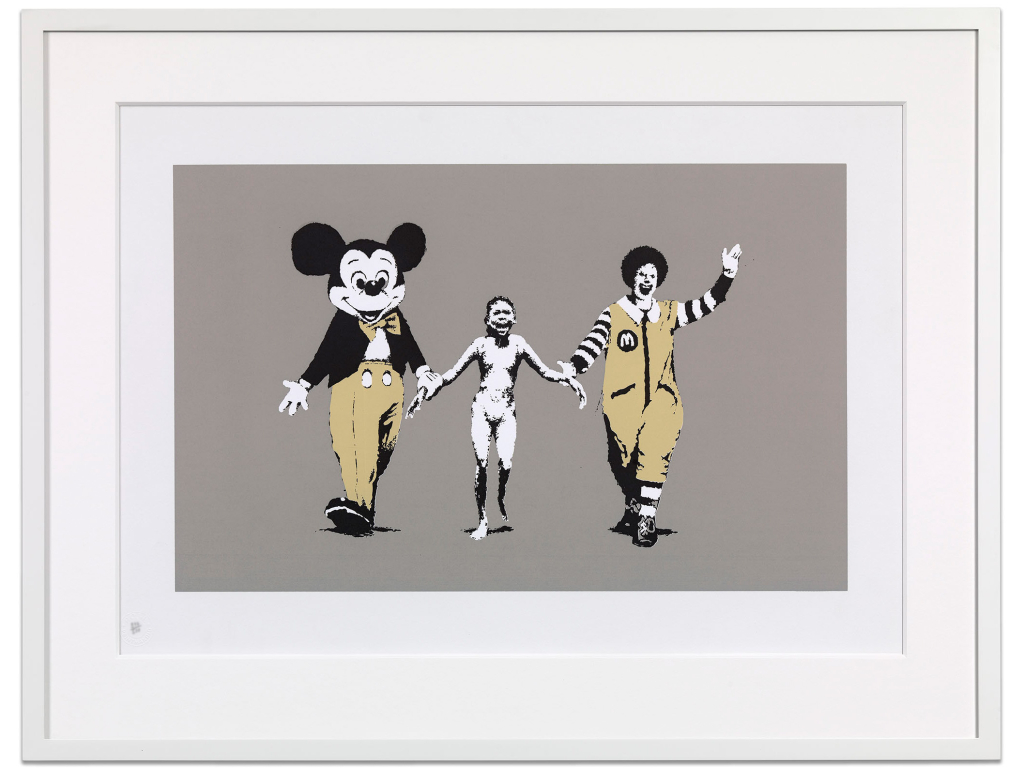
GraffitiStreet regularly advises collectors on authenticated Banksy prints and secondary-market works. Every Banksy edition should be supported by a Pest Control certificate of authenticity, clear provenance and a professional condition assessment before purchase.
Explore Banksy with GraffitiStreet
GraffitiStreet has worked with Banksy prints and collectors for more than a decade, offering specialist guidance on authenticated editions, provenance, condition, framing and the secondary market. If you are considering adding a Banksy to your collection, selling an existing work or simply want informed advice before making a decision, our team can help you navigate the market with confidence.
Banksy, Napalm, screen print. Pest Control authenticated. Image copyright GraffitiStreet
Available through GraffitiStreet
View all Banksy works available through GraffitiStreet or contact co-founder and Banksy specialist Rosh Boroumand for a private consultation.